Field resource delivery
Officers carry a posse box of forms that's out of date by the time it's restocked.
PatrolDocs puts an agency's victim rights cards, resource brochures, and legally required notices on an officer's phone instead. Update it once, and every officer has it, delivered to someone in the field in under a minute.
Built by a working patrol sergeant with patrol, K9, FTO, and detective assignments across domestic violence, child crimes, and major crimes.

The problem
The paperwork problem
An officer is responsible for making sure they have what they're required to carry: victim rights cards, resource brochures, notices tied to specific offense types. That runs out. A busy shift, a busy week, a pocket, a posse box, or a patrol car that never got restocked, and there's nothing left to hand someone who needs it right then, or it simply gets forgotten in the pace of the shift.
Restocking happens at the station, when there's time. Going through a supply closet to do it turns up its own problems: a stack of forms in languages nobody on shift recognized, older versions still in circulation months after they were replaced, a box of pamphlets nobody remembered ordering and nobody was handing out. Nothing wrong with any of it individually. Just nobody's job to keep current.
There's also a looser gap underneath that one: what state law actually requires an officer to deliver, versus what's written into agency policy, versus what's on file at the station but not routinely carried. Those three don't always line up, and that's rarely anyone's deliberate choice. It's a gap that shows up quietly, in the space between a policy sitting in a binder and a form that made it into someone's hands on scene.
More often than not, what actually gets handed out is the bare minimum, whatever's easiest to remember and easiest to reach, not the full set an agency's policy or state law actually requires. Some of what's required applies to every crime victim, not just the offense types that come to mind first, and that's a gap in awareness more than a gap in effort.
By 2026 the expectation for getting information into someone's hands is digital by default. Print is still the right fallback when a phone dies or a signal drops. It's a poor primary system for something required by law.
The shift
What changes
Right now
- Keeping stock current is the individual officer's job, and it competes with everything else on a shift
- Officers who share cars, or don't have an assigned one, carry whatever happened to be left behind
- Training is a formal process, but it doesn't guarantee every officer carries the same cards or was taught the same set of required resources
- Realizing it's not in your pocket usually happens after you've already gone back to the car to check, and by then it's the next call, with nothing handed to anyone
With PatrolDocs
- The full current library is available from the officer's phone, on demand, with no physical stock to run out of
- An agency updates a document once, and every officer has the current version on their next shift
- Every officer works from the same set, so what gets handed out doesn't depend on who trained whom or which car they're in that day
- Filter by category, check the box, send by QR code, text, or email
Workflow
How it works
The platform comes with a built-in library of state-published resources and a basic set of officer and agency cards, ready to use without building anything from scratch. If an agency's own version of a document is the one that should go out instead of the state default, that's a per-category override, not a platform-wide change. From there, it's four steps in the field.
Browse by category
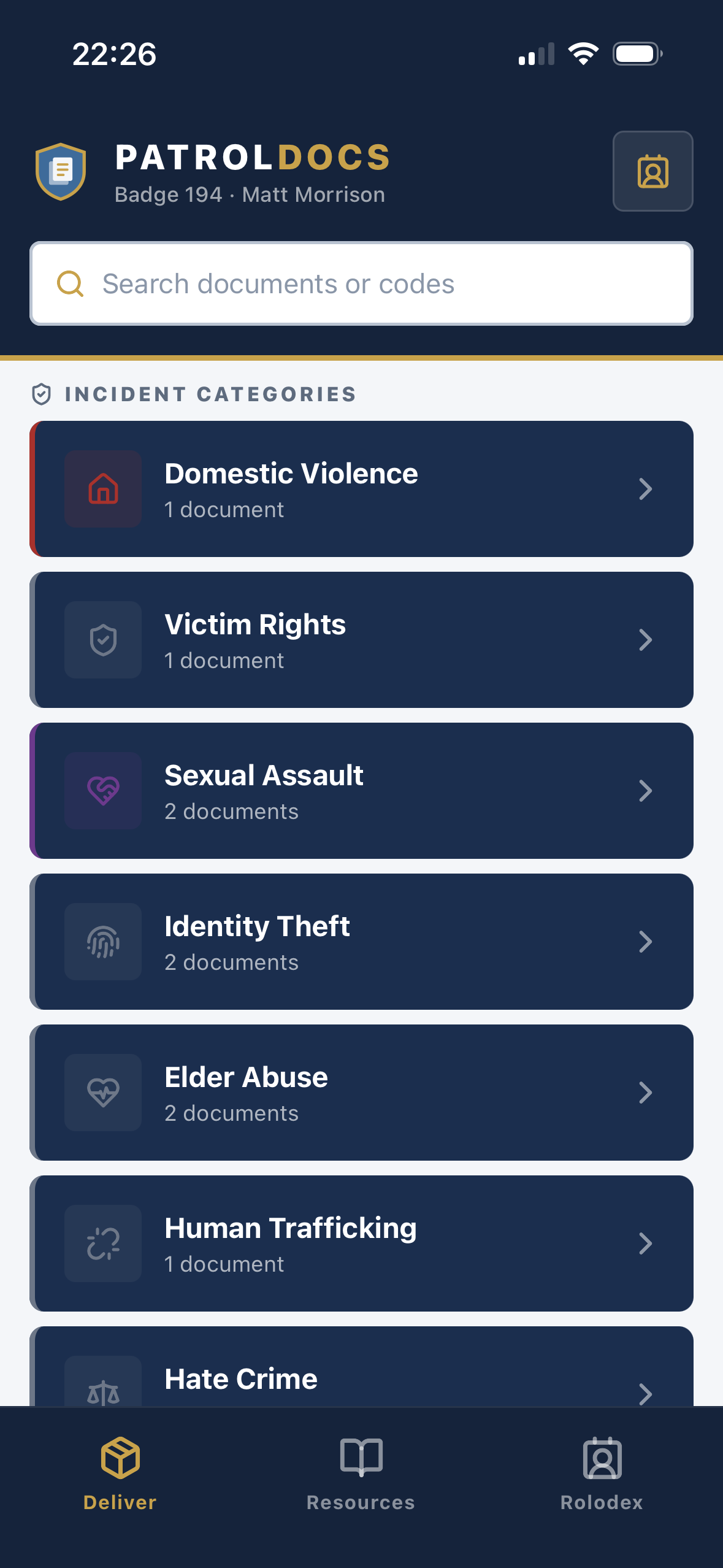
Start from the incident category on the call. Each category shows the documents available, including Domestic Violence, Victim Rights, Sexual Assault, Identity Theft, Elder Abuse, Human Trafficking, and Hate Crime.
Select the documents
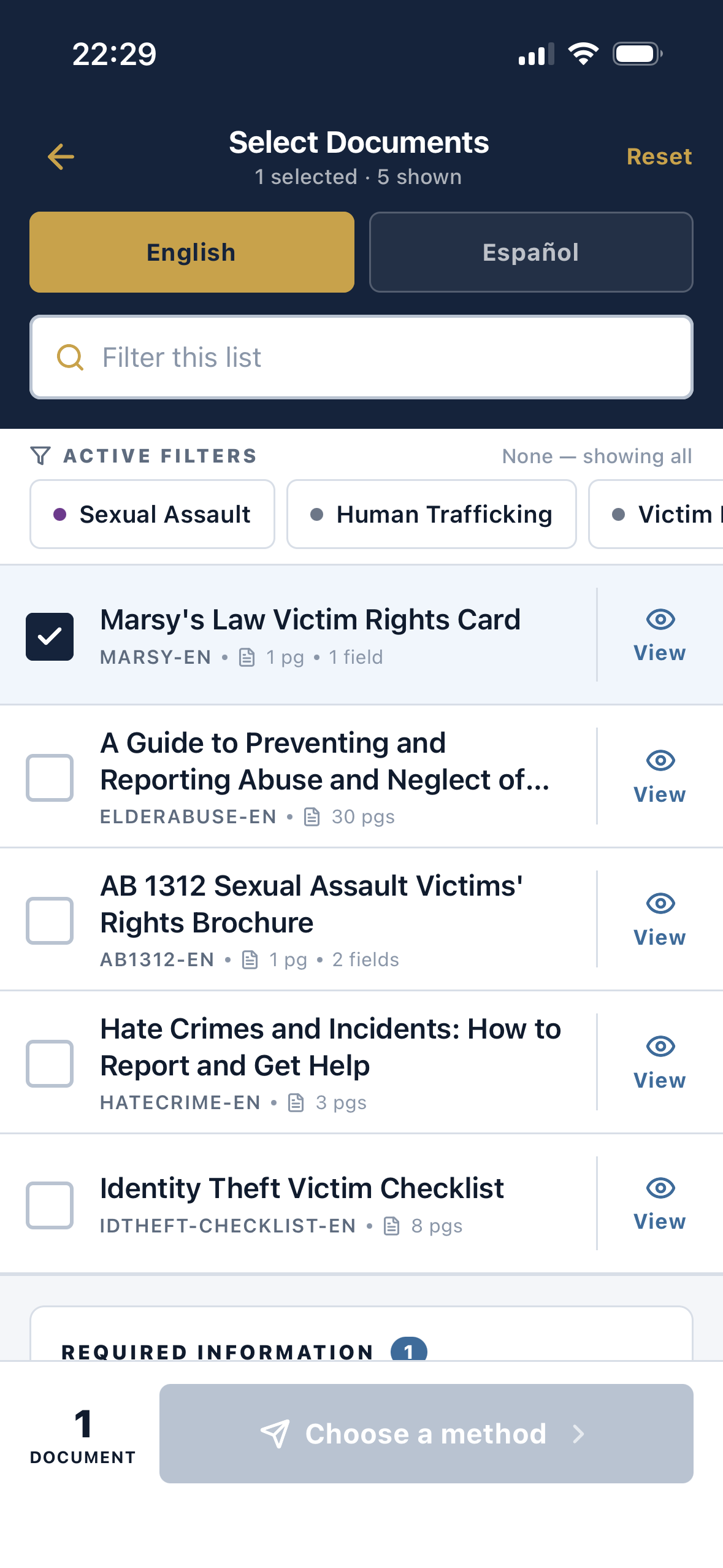
Check the specific document or documents needed for the call. The screen includes an English/Español choice and category chips to narrow the list.
Choose how to send it
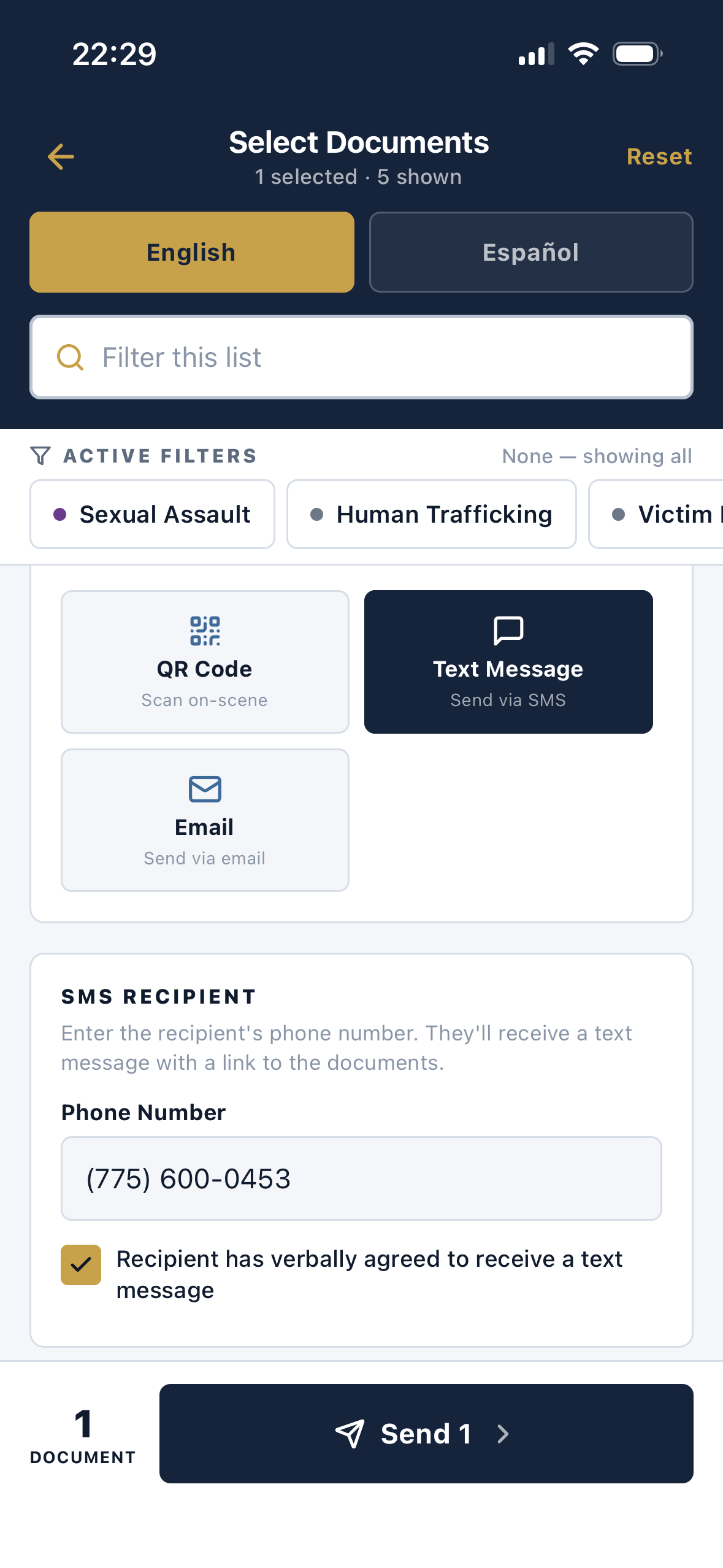
Choose QR code for an on-scene scan, text message for SMS, or email. When text is selected, enter the recipient's phone number and confirm they agreed verbally to receive the message.
Confirmed, on the record
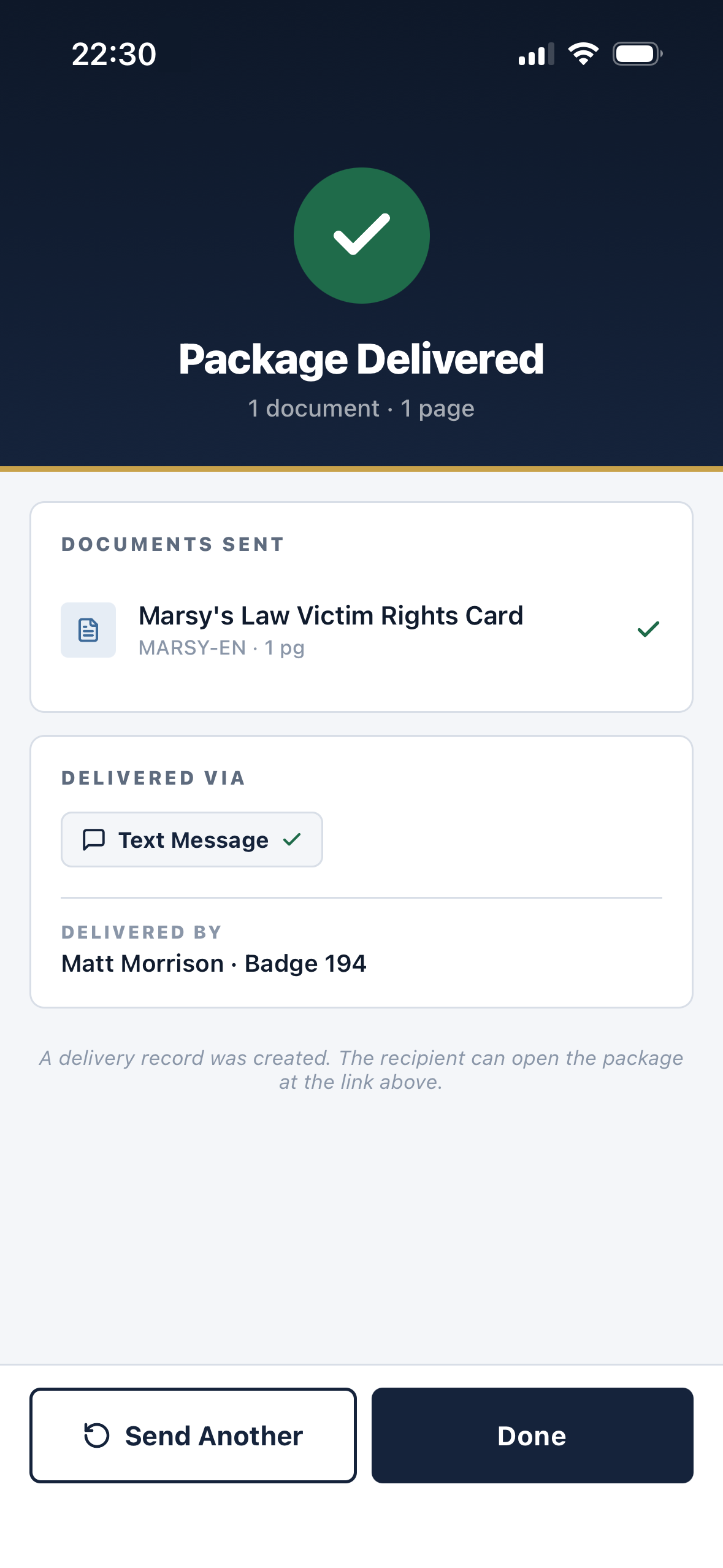
The confirmation shows the document sent, the delivery method, and the officer's name and badge number. It creates an agency delivery record without attaching an investigative narrative.
Training
Every new hire starts with the same set
New officers usually learn which resource cards to carry from whoever trained them, and that knowledge gets passed down inconsistently: a card here, a habit there, nothing written down. Putting the full library in one place means every new hire starts with the same complete set, not whatever their training officer happened to remember to hand them.
Content library
California Statewide Document Library
Every agency starts with the full set of California statewide victim rights and informational documents already loaded in. Officers don't have to search for the right brochure or guess which forms a given investigation requires.
The library covers documents for common investigation types, including:
Marsy's Law Victims' Rights
Sexual Assault Victim Rights
Hate Crime Resources
Identity Theft Information
Elder and Dependent Adult Abuse Resources
Additional statewide resources added as the library grows
Each document is tagged by investigation type and surfaces automatically based on the call an officer is handling. Agencies can add their own local documents and resource guides on top of the state library to build a complete package specific to their community.
The statewide library is updated as official publications change, and updates apply agency-wide without anyone manually replacing old forms in the field.
Privacy & security
What this stores, and what it doesn't
PatrolDocs was built to hold as little as possible. No victim names. No narratives. No investigative reports or evidence.
Case number and kit number are optional fields, and how long they're kept is a setting the agency controls, not something baked into the platform. Recipients never create an account or log in. What we track on their end is limited to whether they opened the page and which resources they tapped, useful for an agency to see whether what's being sent is actually landing, not for tracking the person who received it.
Worst case in a breach: a case number, a kit number, the last four digits of a phone number or a partial email address, a timestamp, which officer sent it, and copies of forms that are already public. No names, no narratives, nothing an officer wouldn't already be comfortable writing on a paper card by hand.
That said, PatrolDocs isn't sold as automatically CJIS-exempt. Every agency still runs its own security and legal review before go-live, as it should.

Background
I ran out of resource cards on a call so many times I have lost count. Standing in someone's living room with nothing left to hand them, right when they needed it most.
Three calls earlier, the last card went out. There's no time to restock between dispatches when you're running from one call to the next.
Read the full story →Current status
Where this stands right now
PatrolDocs is currently piloting in California, starting with the agency where it was built, run by the same sergeant who built it. That's deliberate: testing it against real field conditions before it goes to other agencies.
Work with other agencies happens separately, on its own time, outside of any official capacity. If you're evaluating this for your department, reach out below.
Questions
Common questions
Does this replace paper entirely?
No, and it's not trying to. Paper stays as the fallback. If a phone dies, a signal drops, or an officer just prefers to hand someone a physical card, that option doesn't go away. PatrolDocs is there for the other cases, which in practice is most of them.
What happens if an officer has no signal?
The app queues the selection locally and sends automatically once the officer is back in coverage. Nothing has to be redone by hand, and nothing is lost if a call happens in a dead zone.
What does this cost?
A flat annual fee based on your agency's sworn officer headcount, locked in at signup. No per-seat billing, no metering on how many documents get sent. Reach out for a quote specific to your agency's size.
How long does it take to get an agency set up?
An admin uploads the agency's documents and branding once, invites officers, and they're using it on their next shift. Local documents on top of the state library can be added at any time, not just at setup.
Who can see what an officer delivers?
The agency, through its own admin console. PatrolDocs doesn't sell data or share it outside the agency for any other purpose. Sending a text or email does mean the service that actually delivers it, Twilio or Resend, briefly handles the contact info needed to send it. That's true of any text or email, not something specific to PatrolDocs.
Get in touch
Contact
Questions, a pilot for your agency, current pricing, or a look at the full document library before you commit to anything.
info@patroldocs.com